Neuroscience Projects

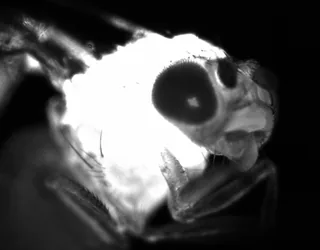
Black-and-white close-up of a fruit fly's head and compound eye

Active vision in Drosophila

Max Planck Institute for Biological Intelligence · with Lisa Fenk

I explored the idea if flies adjust their spontaneous retinal movements to visual scene characteristics. I developed a saccade detection algorithm and analysed the relationship between saccade frequency and visual scene statistics of gratings and natural images. Ball movements were also tracked to study the relationship between saccades and behavioural responses to visual stimuli.

TL;DR: Correlating retinal movements with behavioural responses to visual stimuli, asking how an animal shapes its own sensory input through the loop between neural activity, body, and environment.
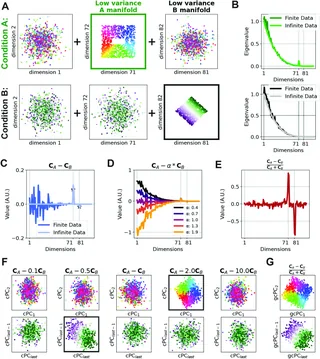
Synthetic conditions A and B showing a low-variance manifold in condition A

Generalized contrastive PCA

Albert Einstein College of Medicine · with Eliezyer de Oliveira and Luke Sjulson

We developed gcPCA, a hyperparameter-free method for finding low-dimensional patterns enriched in one of two high-dimensional datasets. Unlike contrastive PCA, it can compare conditions symmetrically and return a unique solution. We demonstrated it on synthetic data, hippocampal recordings, and single-cell RNA sequencing.

TL;DR: Compare two high-dimensional datasets without choosing contrastive PCA’s α hyperparameter.

Read the paper

BibTeX for paper
@article{de2025identifying,
	author = {de Oliveira, Eliezyer Fermino and Garg, Pranjal and Hjerling-Leffler, Jens and Batista-Brito, Renata and Sjulson, Lucas},
	journal = {PLOS Computational Biology},
	number = {2},
	year = {2025},
	pages = {e1012747},
	publisher = {Public Library of Science San Francisco, CA USA},
	title = {Identifying patterns differing between high-dimensional datasets with generalized contrastive {PCA}},
	volume = {21},
}

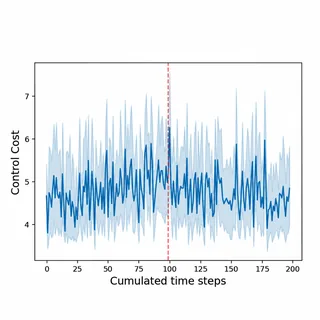
Control cost across 200 cumulated time steps, with a perturbation marked at time step 100

pS4: periodic structured state-space models of hippocampal dynamics

With V. Nema · Poster at NeurIPS ’24 Women in Machine Learning (WiML)

I introduced pS4, a periodic structured state-space model for low-dimensional hippocampal population activity. It treats the activity as a linear time-varying control system aligned to ongoing oscillations, using control cost and feedback gains to compare the learned dynamics before and after stimulus perturbation.

TL;DR: pS4 models oscillation-aligned hippocampal dynamics as a periodic control system.

BibTeX for workshop paper
@inproceedings{garg2024modeling,
	author = {Garg, Pranjal and Nema, V.},
	booktitle = {NeurIPS 2024 {Workshop} on {Women} in {Machine} {Learning} ({WiML})},
	year = {2024},
	title = {Modeling {Neural} {Dynamics} {Using} {Periodic} {Structured} {State}-{Space} {Models}},
	url = {https://neurips.cc/virtual/2024/109052},
	howpublished = {https://neurips.cc/virtual/2024/109052},
}

Abstract illustration of a neural network

Orbitofrontal dynamics in social interaction and reward

Southern Illinois University · with Duda Kvitsiani and Ebru Demir

With Duda Kvitsiani and Ebru Demir at Southern Illinois University, I analysed calcium-imaging recordings and trained recurrent neural networks to study orbitofrontal activity during social interaction and water reward.

TL;DR: Used recordings and neural networks to study how orbitofrontal populations represent social and reward events.

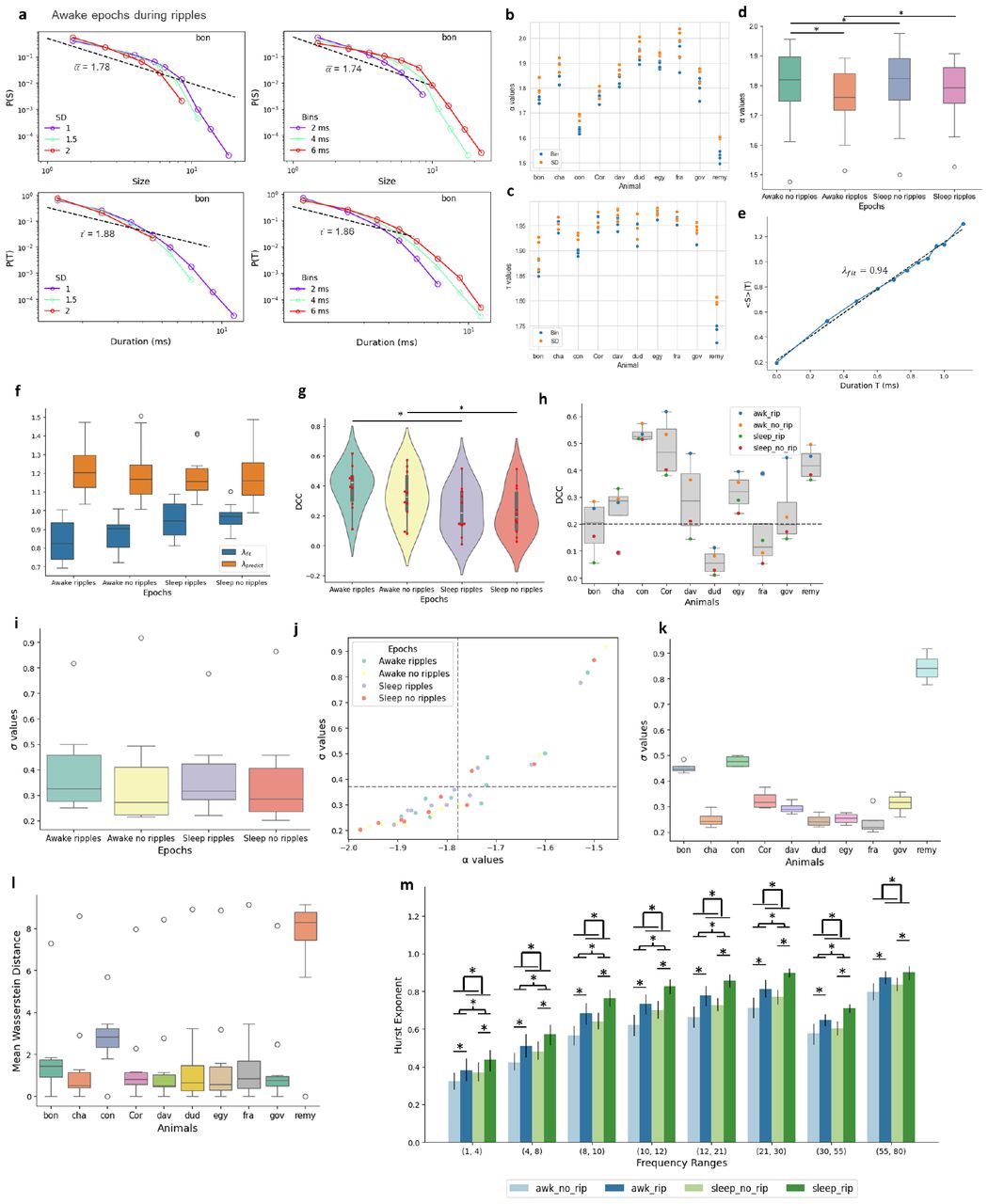
Avalanche-size probability during awake hippocampal ripple epochs at three standard-deviation thresholds

Criticality in hippocampal dynamics

Independent research · Poster at SfN ’24

I tested whether hippocampal sharp-wave ripples relate to neuronal criticality in public recordings. I measured avalanches and branching behaviour across awake and sleep states and found mixed signatures of subcritical dynamics.

TL;DR: Hippocampal activity showed mixed signs of subcritical dynamics across wake and sleep.

Read the preprint

BibTeX for preprint
@article{garg2023mixed,
	author = {Garg, Pranjal},
	journal = {bioRxiv},
	doi = {10.1101/2023.10.30.564597},
	year = {2023},
	publisher = {Cold Spring Harbor Laboratory},
	title = {Mixed signatures for subcritical dynamics in rodent hippocampus during sleep and awake epochs},
	url = {https://doi.org/10.1101/2023.10.30.564597},
}

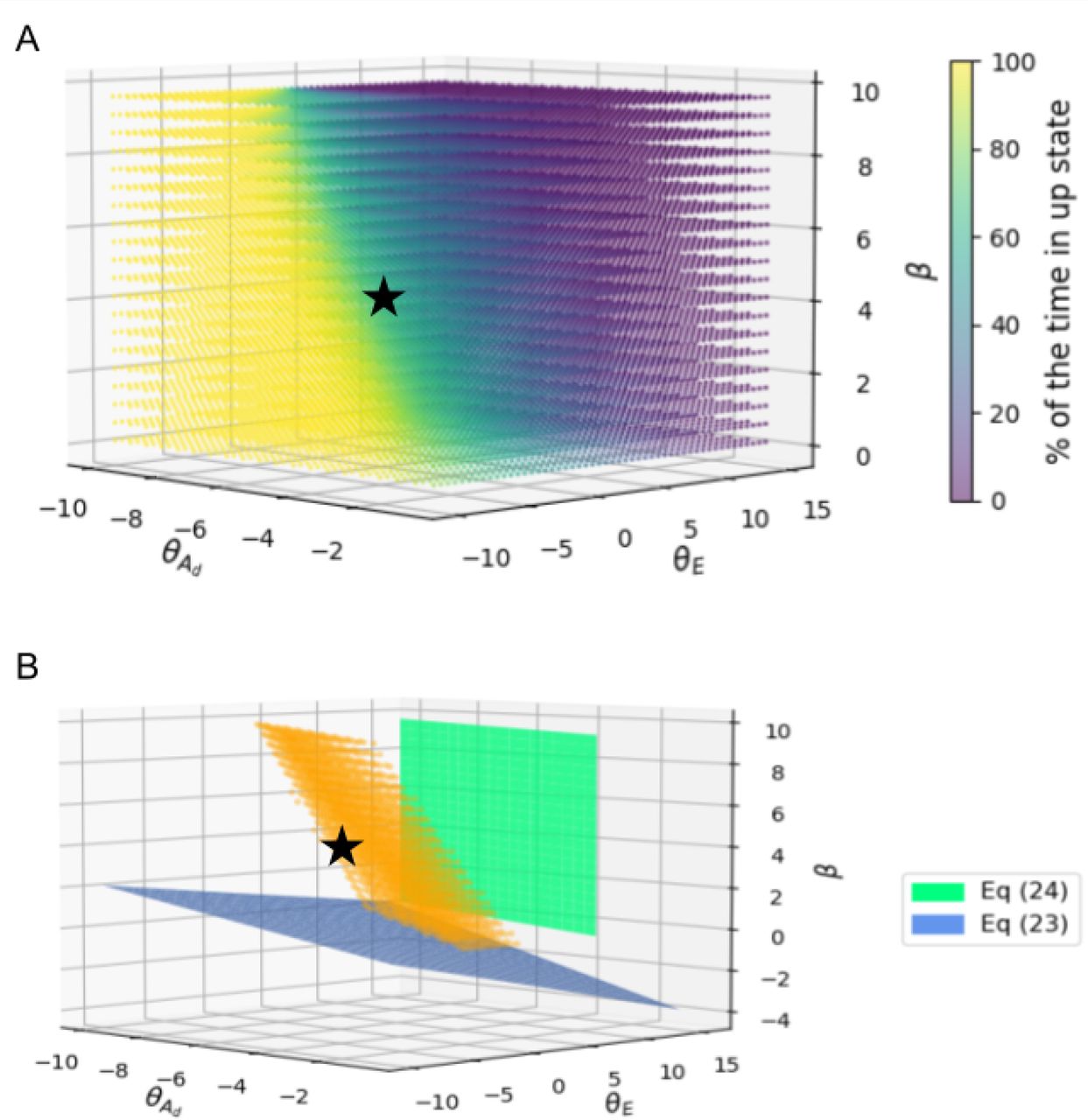
Three-dimensional map of the model's time in the Up state across beta, theta E, and theta A-d parameter values

Astrocytic control of cortical Up–Down states

With Jay Verma · Poster at The Fourth International Convention on the Mathematics of Neuroscience and AI ’23

We extended an existing model of cortical Up–Down dynamics by adding depolarizing and hyperpolarizing astrocyte populations. Sensitivity and stability analyses identified a bistable regime and showed that excitatory population thresholds and adaptation strength had the strongest influence on the model’s dynamics.

TL;DR: Tested whether hyperpolarizing astrocytes can support stable cortical Up–Down dynamics.

Read the preprint

BibTeX for preprint
@article{verma2023computational,
	author = {Verma, Jay and Garg, Pranjal},
	journal = {bioRxiv},
	doi = {10.1101/2023.10.16.562461},
	year = {2023},
	publisher = {Cold Spring Harbor Laboratory},
	title = {Computational {Modeling} of {Hyperpolarizing} {Astrocytic} {Influence} on {Cortical} {Up}-{Down} {State} {Transitions}},
	url = {https://doi.org/10.1101/2023.10.16.562461},
}

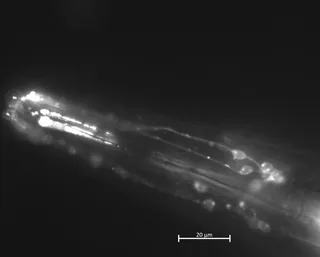
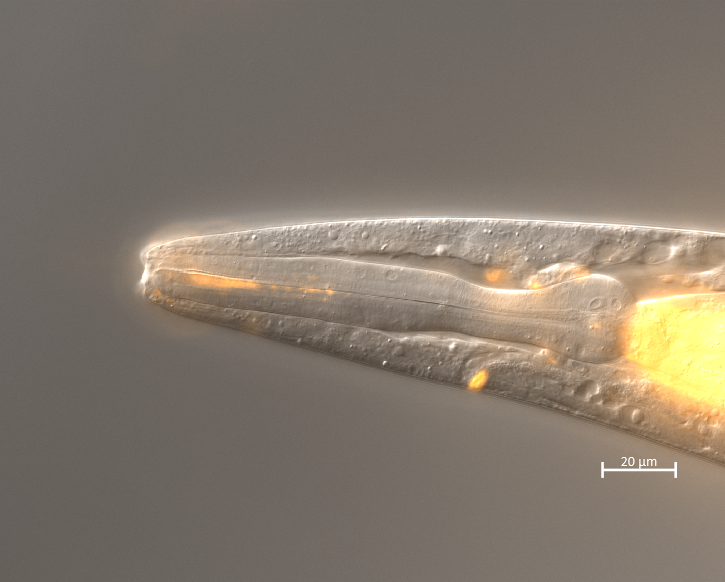
Grayscale fluorescence image of stained sensory neurons Orange fluorescence image of a stained nematode

Sensory neurons in Steinernema hermaphroditum

Caltech SURF · with Chieh-Hsiang Tan and Paul W. Sternberg

I developed a DiI fluorescence staining protocol for head sensory neurons in Steinernema hermaphroditum and compared their positions with those in C. elegans.

TL;DR: A staining protocol made the nematode's sensory neurons easier to identify and compare.

Read the paper

BibTeX for paper
@article{garg2022dii,
	author = {Garg, Pranjal and Tan, Chieh-Hsiang and Sternberg, Paul W},
	journal = {microPublication biology},
	doi = {10.17912/micropub.biology.000516},
	year = {2022},
	title = {DiI staining of sensory neurons in the entomopathogenic nematode {Steinernema} hermaphroditum},
	url = {https://doi.org/10.17912/micropub.biology.000516},
	howpublished = {https://doi.org/10.17912/micropub.biology.000516},
	volume = {2022},
}